

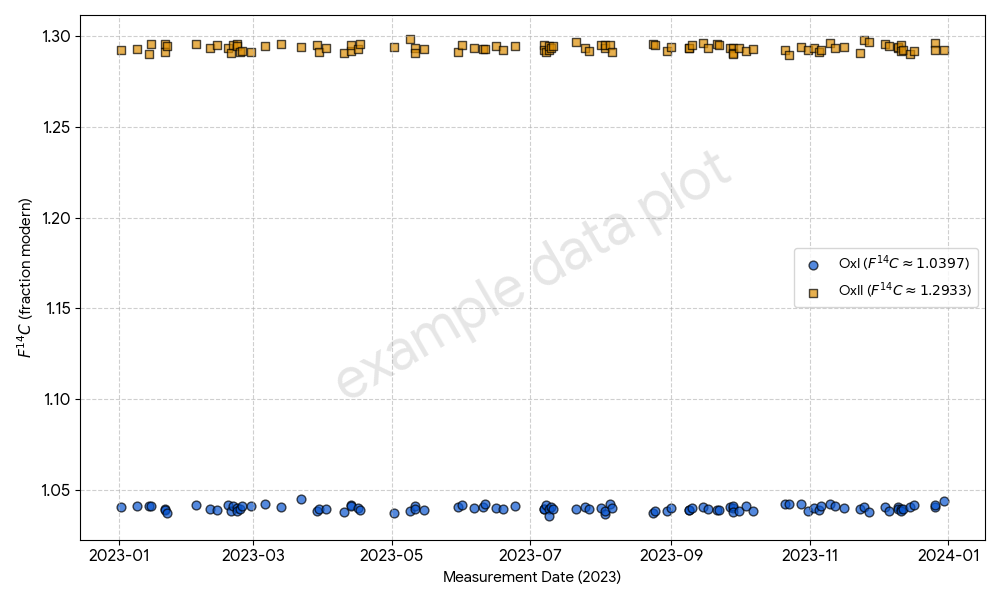
Running Primary Standard Data Chart
Running Instrument Blank Data Chart
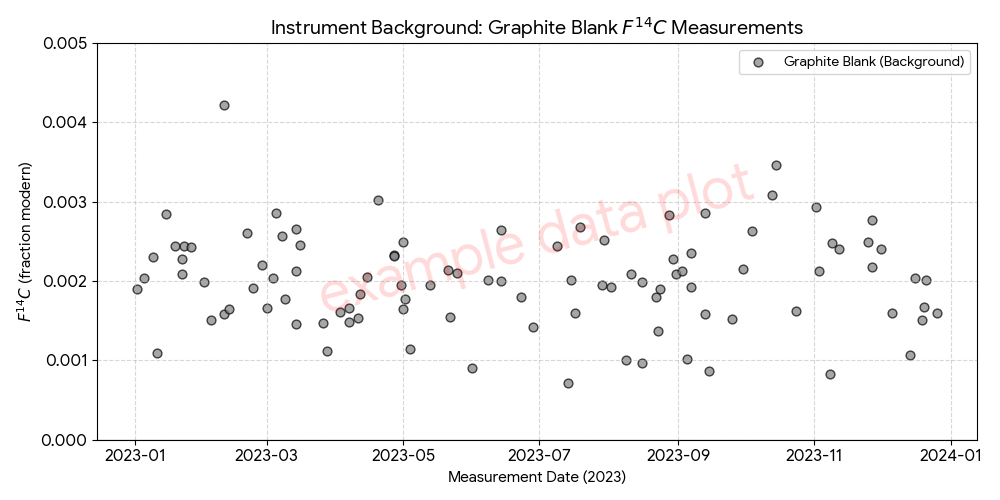
(Additional process blank data charts will be displayed here)
Standard & Blank Cumulative Totals
(Just placeholders for now – ultimately will display the total numbers of standards and blanks analyzed)
External (Primary) Standards
There are relatively few radiocarbon primary standards and they are in relatively short-supply.
Blank/Dead
- IAEA-C1 (Carrera Marble carbonate)
- NBS-19 (TS Limestone carbonate)
Intermediate age
- IAEA-C2 (Molasse Basin Travertine – carbonate)
- IAEA-C7 (oxalic acid)
Modern
- OX-I
- OX-II
Internal (Secondary) Standards
The AURORA laboratory staff are continuously engaged in the identification, evaluation, and calibration of secondary radiocarbon standards and blanks to ensure the robustness of our analytical framework. Our objective is to develop and maintain an extensive suite of well-characterized secondary standards that span the full diversity of sample materials routinely processed in the laboratory, while also covering the entire radiocarbon age range from modern carbon through to radiocarbon-dead backgrounds. These secondary standards and blanks are essential for monitoring instrument performance, validating measurement accuracy, and quantifying background contributions. By regularly incorporating them into analytical sequences, we are able to detect systematic biases, assess reproducibility, and ensure inter-run and long-term consistency. Ultimately, this rigorous approach underpins our ability to achieve and maintain the highest possible data quality, providing confidence in both the precision and accuracy of every radiocarbon age determination produced by the laboratory.
Below is a list of secondary standards currently in use and currently being evaluated. The candidate materials must possess the following properties to be adopted for routine use:
- Homogenous – must give consistent results regardless of what part of the sample is analyzed (e.g. a subsample taken from the edge must yield the same result as a subsample taken from the center)
- Chemically and biologically stable – must not be measurably deteriorating over the standard’s intended lifetime (e.g. no measurable reaction with air, no appreciable bacterial or fungal activity)
- Representative – must be a representative of the sample type
- Sufficient quantity available – if we take the time to evaluate and calibrate a standard material, then there needs to be enough of it to last many years of routine use
Blank/Dead
- Kauri wood (~50,000 Yrs BP)
- Mastodon Bone
- Skin
- Muscle Tissue
- MFL (Nylon Fishing Line)
- Graphite-iron powder mixture (instrument blank)
Intermediate age
- Bog Oak wood (~6,000 – 4,000 Yrs BP)
- Cypress sinker wood
- Bethlehem Olive wood (~300 Yrs BP)
- Coral Skeleton
- Conch shell
- Foraminifera
- Peat Moss
- Travertine
- Mammoth Bone
- Mammoth Tooth
- Bison Horn
- Mammoth Tusk
Modern
- Shell
- Collagen (chicken, bovine, marine)
- Cicada nymph molts
- Diatoms
- Whale Bone
- Bear Skull Bone
- Beaver Skin
- Beaver Fur
- Moose Teeth
- Walrus Tusk
The Glasgow International Radiocarbon Inter-comparison sample set.
We were very fortunate to receive small quantities of most of the sample materials used for the Glasgow International Radiocarbon Intercomparison (GIRI) (many thanks to Elaine Dunbar). These materials with their consensus values contribute greatly toward our calibration efforts.
As analysis data is accumulated on these samples, it will be tabulated here.